[bra_border_divider top=’5′ bottom=’15’]
Dr. Jeffrey Chilcote, Dunlap Institute
Thursday, 9 October, noon – AB Lounge
The Gemini Planet Imager (GPI) is one of a new generation of instruments designed to directly image extrasolar planets in the outer solar systems of young main sequence stars. By combining a 1700-actuator adaptive optics system, an apodized-pupil Lyot coronagraph, a precision interferometric infrared wavefront sensor, and an integral field spectrograph (IFS), GPI’s goal is more than an order of magnitude improvement in contrast compared to existing high contrast systems.
This AID focuses on the construction, performance and characterization of the GPI IFS which is based on concepts from the OSIRIS instrument employed at Keck. Like OSIRIS, the IFS utilizes an infrared transmissive lenslet array to sample an approximate 2.7 x 2.7 arcsecond field of view at the diffraction limit of the Gemini Telescopes. The IFS provides over 36,000 simultaneous low-resolution (R ~ 45) spectra across five bands between 1 and 2.5μm.
The IFS construction was based at the University of California, Los Angeles in collaboration with the Université de Montreal, Immervision and Lawrence Livermore National Laboratory. GPI is the newest instrument at Gemini South, beginning normal science operations this fall.
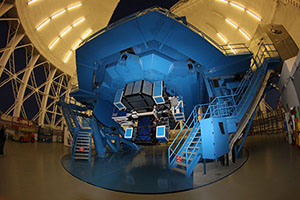
GPI mounted on the telescope. Image: Dr. Jérome Maire; Dunlap Institute