



Leading up to April 8, 2024, millions of Canadians were counting down the days to a once-in-a-lifetime total solar eclipse.
As the Moon passes between the Earth and the Sun that Monday afternoon, many in Southern Ontario, Quebec, and the Atlantic provinces were able to witness one of the most incredible natural phenomenon we can experience from Earth.
Another total solar eclipse won’t be seen again in Eastern Canada until 2079.
The eclipse was a valuable learning opportunity that connects to what students are learning about in their science, math, history, and art classes. It was also an opportunity for people of any age to experience one of the rarest wonders of our solar system around family, friends, and our community members.
At the Dunlap Institute, we prepared Canadians with free resources, workshops and events, and safe viewing tools.
Eclipse 2024 Livestream: Chasing the Shadow from Niagara to Newfoundland
No matter where you were in the world on April 8, you could chase the Moon’s shadow with us across Canada!
The Dunlap Institute will hosted a livestream with partners across Ontario, Quebec, and the Atlantic provinces to follow the best views of the total solar eclipse.
Rewatch the livestream recording to hear from astronomers at the University of Toronto the science of eclipses, the sounds of space, and important safety tips while watching a dazzling celestial show.
Free eclipse workshops at the Toronto Public Library

We hosted dozens of free workshops across Toronto in partnership with the Toronto Public Library to help attendees safely enjoy the total solar eclipse on April 8 in several different ways!
Astronomers from the University of Toronto guided participants through making their own pinhole solar viewers, looking at the surface of the sun through telescopes equipped with solar filters, and creating their own scale model of the Earth-Moon-Sun system.
We hosted 37 workshops at different library branches for over 1000 library patrons.
Eclipse glasses

With our partners at Discover the Universe, we designed and printed about 350,000 eclipse glasses.
Eclipse glasses were available for free at the Toronto Public Library during our workshops and at the circulation desk of all branches. We distributed almost 42,000 glasses to Toronto residents through the libraries.
Discover the Universe, with support from the Dunlap Institute, distributed over 300,000 eclipse glasses to teachers and schools across Eastern Canada to share with their students.
Where and when to see the eclipse
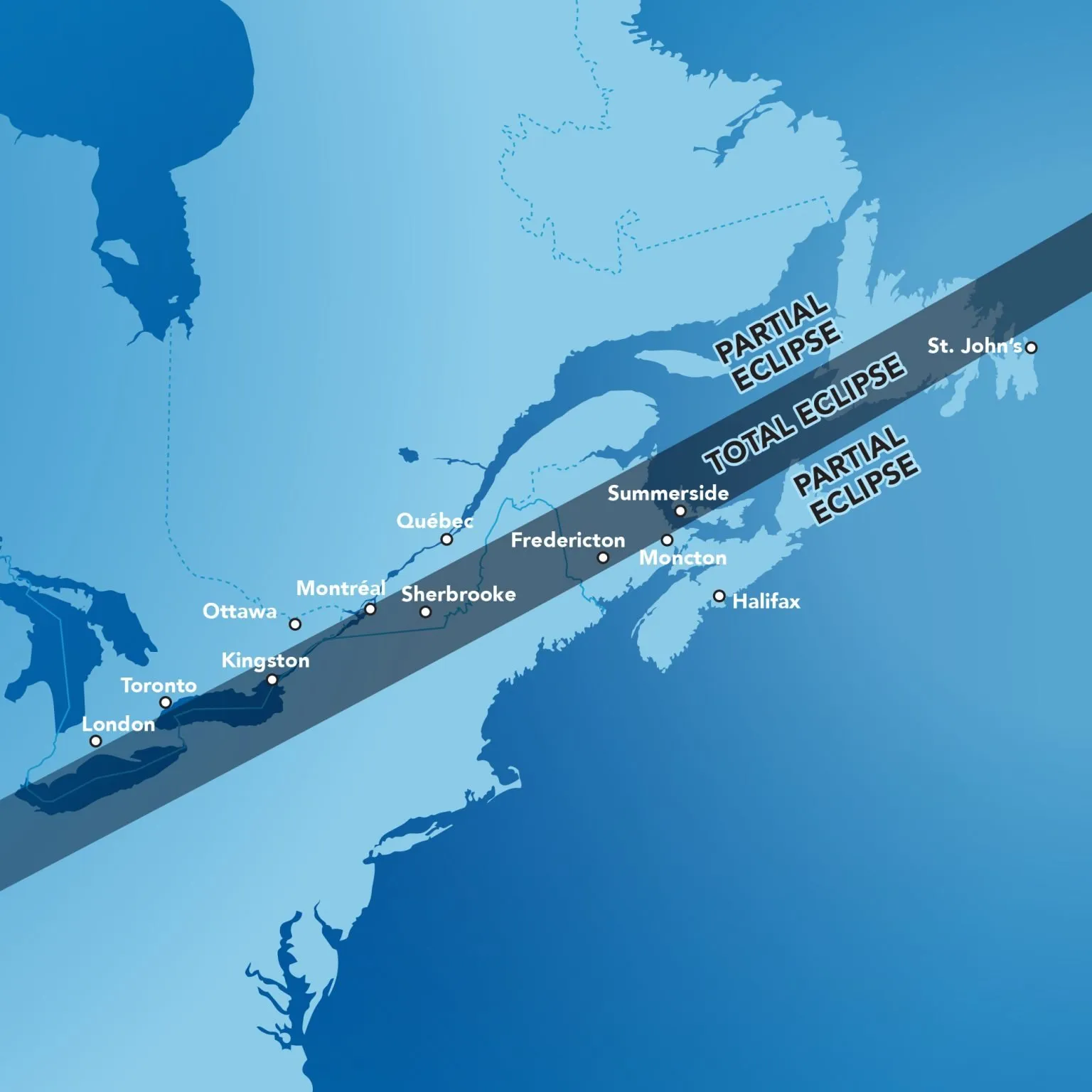
During a total solar eclipse, the Moon completely blocks out the Sun at its maximum. This can only be seen from the path of the Moon’s shadow, called the path of totality.
On April 8, 2024, the path of totality covered well-populated Canadian cities and towns like Hamilton and Kingston in Ontario, Sherbrooke and parts of Montreal in Quebec, Fredericton in New Brunswick, Summerside in Prince Edward Island, and Gander in Newfoundland.
From beginning to end, the eclipse lasted about two hours. The eclipse started, reached its maximum, and ended at different times during the afternoon depending on location, starting later in locations further East.
Is it safe to watch an eclipse?
It is completely safe for people of all ages to observe the eclipse while wearing verified eclipse glasses or using indirect viewing methods, like a pinhole viewer.
The Sun is no more or less dangerous to look at during a solar eclipse, and just like any other day, should never be looked directly without the proper protection (sunglasses are not a substitute for verified eclipse glasses).
If you are in the path of totality, you can take off your eclipse glasses to view the eclipse maximum, or when you can no longer see the Sun through your eclipse glasses.
We caught up with Professor Emeritus in Optometry and amateur astronomer Ralph Chou for a closer look at how to safely view an eclipse.
What is a solar eclipse?
A partial or total solar eclipse happens when the Moon crosses in between the Sun and the Earth.
There are two to five solar eclipses somewhere in the world every year. But total solar eclipses occur just once approximately every 18 months.
Solar eclipses are significant in many different cultures around the world. Dunlap Institute Professor Laurie Rousseau-Nepton has brought together Samantha Doxtator and Melanie Demers to explain the importance of the Sun, Moon, and eclipses in Innu, Oneida, and Mohawk cultures.
What was seen and felt on April 8
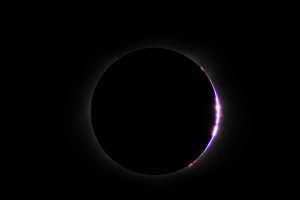
As the Moon passed in front of the Sun, the sky dimmed and one could notice the temperature cool by a couple degrees.
People in the path of totality also saw some light streaking out from behind the Moon. This was the outer layers of the Sun’s atmosphere, or its corona. At the eclipse maximum, when the Moon completely covered the Sun, it was safe to remove one’s eclipse glasses and look directly at the eclipse.
Outside the path of totality, viewers will still saw an incredible partial eclipse as the Moon covered a part of the Sun. The further away one was from the path, the less coverage one would see. Even during a partial eclipse, the sky will darkened as the Moon blocked parts of the Sun, leaving a sliver of light.
Essential Resources
- Eclipse 2024 Livestream: Chasing the Shadow from Niagara to Newfoundland
- Eclipse workshops at the Toronto Public Library
- Discover the Universe’s resources for educators
- Our call for no kids to be left inside on eclipse day
- University of Toronto eclipse stories
- Where to buy eclipse glasses, solar viewers, and filters
- Royal Astronomical Society of Canada eclipse resources and events
Looking for more information or to speak to an expert at U of T?
Contact us at media@dunlap.utoronto.ca


