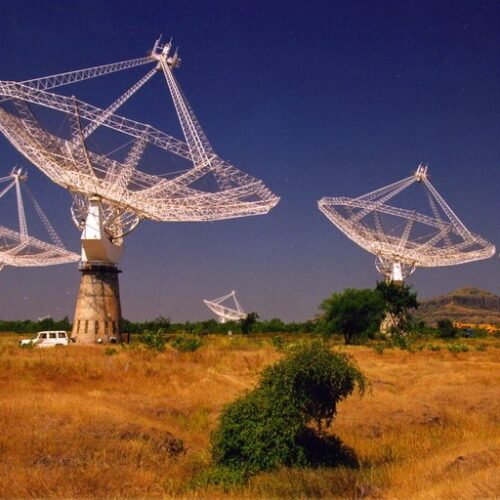
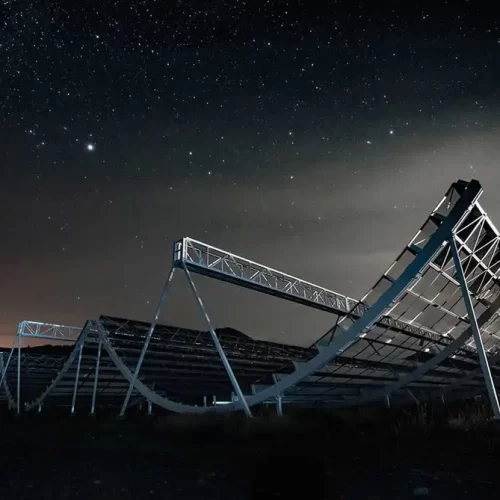
The Algonquin Radio Observatory, located in central Ontario, is home to the 150-foot (46m) radio dish where decades ago the technique of Very-Long-Baseline Interferometry (VLBI) was invented. Using VLBI, astronomers combine disparate telescopes into single instruments with effective diameters comparable to the diameter of the Earth.
Following a brief closure in the last decade, ARO has reopened under private management, and University of Toronto astronomers, postdocs and graduate students have been working to re-commission the 46m dish with new receivers and signal processing backends.
U of T astronomers, including Professor Keith Vanderlinde, are conducting an ongoing VLBI observing program using the ARO and GMRT in an attempt to measure the mass of a neutron star 3000 light-years from Earth.