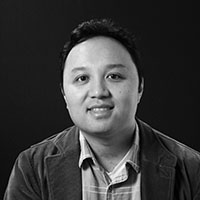
Jo Bovy
Associate Graduate Chair, Professor
Research:
Galactic dynamics; galactic structure and evolution; dark matter; chemical abundances and spectroscopy; data modeling and analysis techniques
Education:
Ph.D. 2011 New York
I am a Professor and Canada Research Chair in Galactic Astrophysics in the Astronomy and Astrophysics Department at the University of Toronto. My research is currently mostly focused on understanding the dynamical structure, formation, and evolution of the Milky Way, but I am interested in a variety of problems in astrophysics, especially those that involve large-scale data analysis. These days much of my research revolves around the Gaia data.
I am the main developer of galpy, a well-tested, well-documented python library for galactic dynamics. For more information on other code with general usefulness, see the code section of this website or my GitHub profile. I strongly believe that scientific software should be freely available and open source; all of the code used for many of my papers is available online (search for the [code] links on my publications page)
I am currently working on a new graduate textbook on galaxies with the title “Dynamics and Astrophysics of Galaxies”. A draft is available at galaxiesbook.org. Aside from your standard, textbook material, the book contains a multitude of Python code examples that you can even run in your browser, and some interactive examples. Check it out and please contact me with any feedback on the text and the HTML experience.
I served as the Science Working Group Chair for the APOGEE survey, which used high-resolution, high signal-to-noise infrared spectroscopy to investigate the structure of the bulge and disk regions of the Milky Way, as well as many other topics in stellar and galactic astrophysics. Currently, I am a member of the follow-up APOGEE-2 survey, which is extending APOGEE’s coverage of the Milky Way to larger distances and to the Southern hemisphere.