



Dunlap Institute astronomers make observations and use data collected at observatories around the world—and in orbit above it.

Atacama Large Millimeter/submillimeter Array (ALMA)
ALMA is one of the largest, ground-based astronomical facilities ever built. The array of 66 antennas is located on the Chajnantor plateau in northern Chile, at an altitude of 5000 metres.

Algonquin Radio Observatory (ARO)
The Algonquin Radio Observatory, located in central Ontario, is home to the 150-foot radio dish where decades ago the technique of Very-Long-Baseline Interferometry (VLBI) was invented.

ASKAP
ASKAP is a next-generation radio telescope comprising an array of 36, 12-metre wide antennas at the Murchison Radio-astronomy Observatory in Western Australia. It is designed to observe large areas of the sky with high sensitivity, making it suitable for surveys.

Canadian Hydrogen Intensity Mapping Experiment (CHIME)
CHIME is an innovative radio telescope near Penticton, B.C. which, since it began science operations in the fall of 2017, is mapping the largest volume of space ever surveyed. The map will include a three-dimensional swath of the Universe covering half the sky and with a depth of billions of light years.
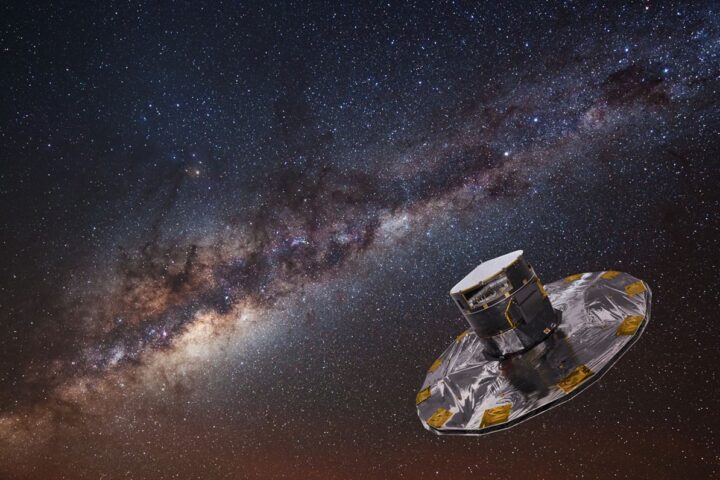
GAIA
The mission of the GAIA spacecraft is to create a dynamic, three-dimensional map of the Milky Way Galaxy by measuring the distances, positions and proper motion of stars. To do this, the spacecraft employs two telescopes, an imaging system, an instrument for measuring the brightness of stars, and a spectrograph.

Gemini Observatory
The Gemini Observatory consists of twin 8.1-meter diameter optical/infrared telescopes located on Mauna Kea in Hawai‘i and on Cerro Pachón in Chile. They are currently two of the largest, most advanced telescopes in the world.

Giant Metrewave Radio Telescope (GMRT)
Located near Pune, India, the GMRT is made up of 30, steerable antennas that are each 45-metres in diameter. The telescope is used to make interferometric observations with with 435 possible pairs of antennas and with a maximum distance between antennas of approximately 25km.

Hubble Space Telescope
The launch of the Hubble Space Telescope in 1990 marked the beginning of a new era in astronomy. Above the obscuring effects of the Earth’s atmosphere, it gave astronomers their clearest view of the Universe.

Murchison Wide-field Array (MWA)
The MWA is located at the Murchison Radioastronomy Observatory in Western Australia, the future site of the SKA (below). It is an interferometric radio telescope with over 2000 separate antennas arranged in 128 groups of 16.

Simons Observatory
The Simons Observatory provides a powerful means to study the Cosmic Microwave Background, Dark Matter, Dark Energy, neutrinos, galaxy clusters and the early, inflationary Universe.